


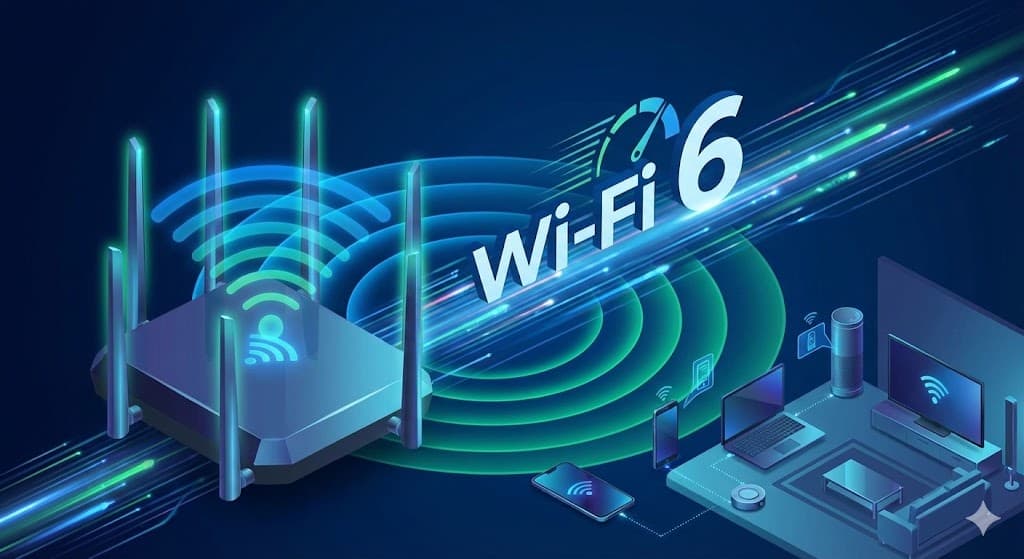
Many people may still be using the routers provided by their ISPs but want a better connection. Why not, many of the latest devices already support WiFi 6?
With the arrival of WiFi 6 in 2019, the WiFi Alliance finally began assigning numbers to the new wireless standard. Meanwhile, WiFi 7 routers also began to attract attention at CES 2024.
With this new network protocol, internet speeds, both in terms of bandwidth and ping, can be even better. Furthermore, data loss can be minimized, even when used simultaneously.
Now, between each generation of Wi-Fi products, users can find the number for each WiFi protocol generation.
What are the benefits of using this latest WiFi technology? Read this article to the end.
WiFi Alliance Vice President of Marketing Speaks Out About WiFi Generation Numbering
According to Kevin Robinson, vice president of marketing at the Austin-based Wi-Fi Alliance, “It’s a way to inform users about the Wi-Fi experience they’ll get.”
For example, an 802.11ac router has a Wi-Fi rating of 5, while an older 802.11n system has a Wi-Fi rating of 4. On the other hand, 802.11a, b, and g devices are considered too old to be included in the Wi-Fi Alliance’s numerical ratings. (Wi-Fi 7 corresponds to 802.11be.)
The idea is to provide buyers with the information they need to make an informed choice,” Robinson said. “Wi-Fi 6 is the best you can get.”
Higher Numbers, Better Performance
What is WiFi 6? WiFi 6 is a wireless internet networking protocol that uses the IEEE 802.11ax standard and operates in the 2.5 GHz and 5 GHz frequencies, with an extension to the WiFi 6E version that can run at 6 GHz.
The new Wi-Fi 6 rating represents a series of improvements that will improve performance while better accommodating the needs of a wide range of devices, from tablets, phones, and notebooks to thermostats, mobile phones, and video cameras.
To get the most out of these changes, a Wi-Fi 6 router and device are required. Robinson says, “Wi-Fi 6 will still work with Wi-Fi 4 and Wi-Fi 5 devices, but it will work best with Wi-Fi 6 devices.”
While new routers risk becoming alphabet soup of acronyms, there’s a lot going on in the new equipment.
For starters, Wi-Fi 6 uses Multi-User Multiple Input, Multiple Output (MU-MIMO) transmission, a technology that debuted on 802.11ac devices but is more commonly used in high-end systems like the Linksys EA8500 (an early model from 2015) and the more modern Netgear Nighthawk XR500.
This newer generation of Wi-Fi also doubles the potential bandwidth from four streams to eight streams.
Another major change is that 802.11ac’s 256 Quadrature Amplitude Modulation (QAM) is replaced by Wi-Fi 6’s 1024 QAM, which broadcasts up to eight spatial data streams.
These additional channels are complemented by Wi-Fi 6’s Operational Mode Indication (OMI). Think of OMI as a communication portal that doesn’t transmit data packets, but rather information about the peak bandwidth that can be efficiently utilized by the receiver. The actual data is then sent in this simplified format.
In addition to using up to eight spatial data streams, Wi-Fi 6 uses Orthogonal Frequency Division Multiple Access (OFDMA) to fit more data into the available spectrum compared to Orthogonal Frequency Division Multiplexing (OFDM) in Wi-Fi 5 (aka 802.11ac). OFDMA divides the available radio spectrum into smaller units to increase throughput and efficiency based on the data traffic flow.
Wi-Fi 6 routers are also smarter about moving data, thanks to a feature called Target Wake Time (TWT). Intended for battery-powered devices like thermostats and water leak sensors, TWT can simultaneously extend device battery life while making the network more efficient by connecting to the router only when needed, eliminating battery-draining wake-up calls.
Wi-Fi Gets Faster and More Devices Can Connect
What can you expect from Wi-Fi 6? Every change results in a maximum throughput of 9.6Gbps under ideal conditions. This means downloading large files can now be significantly shorter.
Wi-Fi 6 can go one step further than home devices to enable simultaneous 4K video streaming, gaming, and use with a wide variety of smart home devices, such as locks, thermostats, and remotely controlled light switches.
This latest technology can serve multiple devices simultaneously without significant performance degradation. “This is for the home of the future,” says Robinson.
However, Wi-Fi technology Wi-Fi 6e doesn’t stop there; it continues to evolve rapidly. The latest development is the FCC’s approval of Wi-Fi 6e, which takes the Wi-Fi 6 specification several steps further.
Wi-Fi 6e has the ability to add 6GHz transmissions to Wi-Fi 6 on the 2.4 and 5GHz bands. The Federal Communications Commission approved the use of the 5.925 to 7.125GHz segment in addition to the unlicensed spectrum segment.
What does Wi-Fi 6e offer? A lot, as the extra bandwidth has the power to speed up data streams with 1 or 2 ms latency, which gamers will surely appreciate.
Of the more than 100 new data channels, there are many 20 and 40 MHz data channels, which are more than double those available in Wi-Fi 6. Additionally, Wi-Fi 6e adds 7 160 MHz channels and up to 14 80 MHz channels for extra performance.
While Wi-Fi 6e’s highest throughput remains at the 9.6Gbps limit of Wi-Fi 6, overall performance is improved by spreading data across three bands to reduce congestion.
This may be useful for those whose networks are overloaded with data packets traveling back and forth. Furthermore, 6GHz data will likely be available at a closer distance from the router than current 5GHz transmissions.
This performance boost could be ideal for boosting the use of augmented reality and virtual reality, which require large amounts of data but don’t require the range that door locks, thermostats, or webcams might require.
Final Words
In short, Wi-Fi 6 is the new standard for wireless networking for various electronic devices, offering numerous advantages.
These include improved download speeds, reduced data loss, and the ability to connect multiple devices simultaneously.
So, it’s no surprise that more and more laptops, phones, routers, and even motherboards now support this technology. This also includes a Ryzen 7800X3D motherboard with an onboard Wi-Fi card that already supports Wi-Fi 7.
This is just the beginning. Wi-Fi 7 is coming soon and could make current specifications look like sluggish devices.
What it can do and when it will appear is anyone’s guess, but if the gap between new protocols continues to widen, expect Wi-Fi 7 to arrive this year.
You can leave comments and provide input in the comments section. Come read other interesting articles on pintartekno.id about Networking, PC & Laptop, or other articles. For more information or if you need anything, please contact us.
References
- Wi-Fi 6: What it is and why it’s better – https://www.tomsguide.com/us/wifi-6-explained,news-28274.html